
Every January, millions of people wake up with fresh determination to transform their lives. But here’s the uncomfortable truth: research shows that 80% of New Year’s resolutions fail by the second week of February. There’s even a name for the Day most people abandon their goals—”Quitter’s Day,” which falls on the second Friday of January (January 10 in 2026).
Yet some people succeed. What separates those who achieve lasting change from those who give up before Valentine’s Day? The answer lies not in willpower, but in how you design your resolutions from the start.
This guide will show you how to create 2026 resolutions that actually stick, using science-backed strategies that work with human psychology instead of fighting against it.
What Are the Most Popular New Year’s Resolutions for 2026?
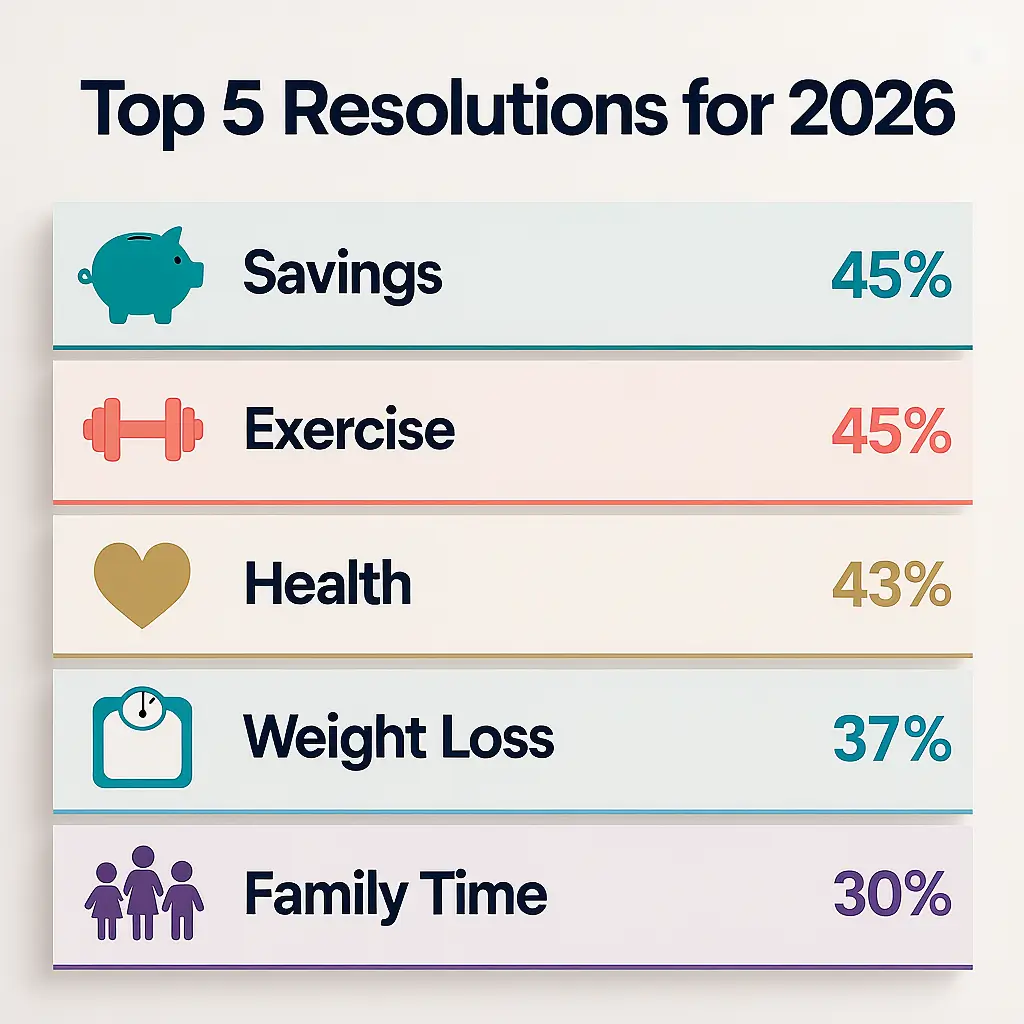
According to recent surveys, these are the top resolutions Americans are making:
- Save money or improve finances (45% of people)
- Exercise more regularly (45% of people)
- Improve overall health (43% of people)
- Lose weight (37% of people)
- Spend more time with family and friends (30% of people)
Notice a pattern? These resolutions are vague, overwhelming, and set people up for failure. “Exercise more” could mean anything. “Save money” has no clear endpoint. These aren’t resolutions—they’re wishes.
Why Do 80% of Resolutions Fail by February?
Understanding why resolutions fail is the first step to creating ones that succeed. Here are the main culprits:
They’re Too Vague
“Get healthy” or “be more productive” sound inspiring, but your brain has no idea what these actually mean. Without specific, measurable targets, you can’t track progress or know when you’ve succeeded.
They’re Too Extreme
Going from never exercising to planning daily two-hour gym sessions is like trying to sprint a marathon. Your brain perceives extreme changes as threats, triggering resistance and stress.
There’s No Accountability System
Most people set resolutions in private and never share them with anyone. Without external accountability or tracking mechanisms, it’s easy to abandon goals when motivation fades quietly.
They Focus on Outcomes Instead of Systems
“Lose 30 pounds” is an outcome. “Eat protein at every meal” is a system. Outcomes are outside your direct control and depend on many variables. Systems are behaviors you can control every single Day.
They Ignore Your Environment
Willpower is a limited resource. If your environment constantly works against your goals (junk food in the pantry, TV remote always within reach), you’re fighting an uphill battle with depleted energy.

What Is the SMART Goal Framework for Resolutions?
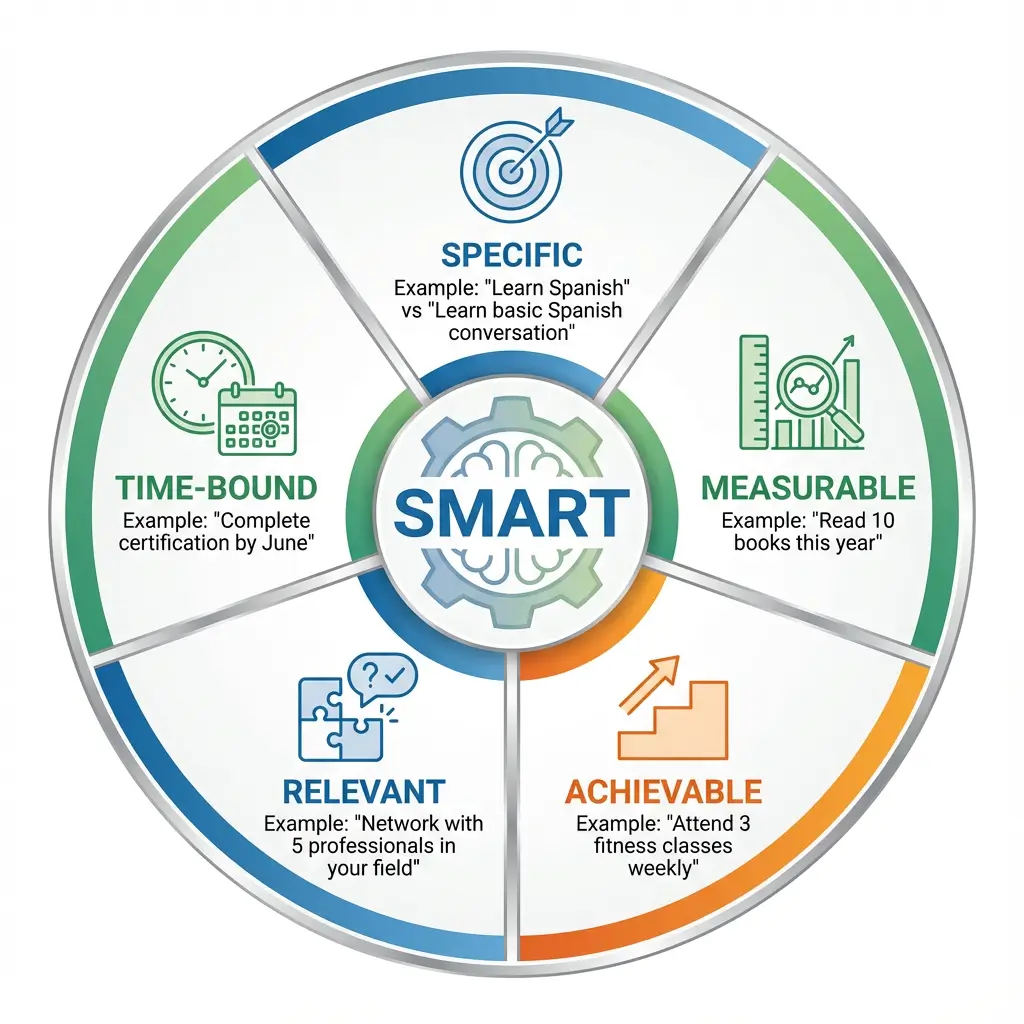
The SMART framework transforms vague wishes into actionable plans. Here’s how to apply it to your 2026 resolutions:
Specific
Bad: “Get in shape.“
Good: “Complete three 30-minute strength training sessions per week.”
Measurable
Bad: “Save more money.“
Good: “Save $400 per month by automatically transferring funds on payda.y“
Achievable
Bad: “Never eat sugar again.“
Good: “Limit desserts to twice per week, down from daily.y“
Relevant
Ask: Does this resolution align with my actual values and life circumstances? A resolution to wake up at 5 AM might not be relevant if you work night shifts or have young children who wake frequently.
Time-Bound
Bad: “Eventually run a marathon.“
Good: “Complete a 5K by March 31, 10K by June 30, half-marathon by October 3.1.“
How Do Different Generations Approach Resolutions?
Research shows that different age groups respond to failure and goal-setting in distinct ways:
Gen Z (Born 1997-2012)
Characteristics: Digital natives who value authenticity and mental health
What Works:
- Social media accountability (posting progress publicly)
- Gamification and app-based tracking
- Resolutions focused on mental health and self-care
- Short-term sprints (30-day challenges) rather than year-long goals
Common Pitfall: Comparison culture on social media leading to unrealistic expectations
Millennials (Born 1981-1996)
Characteristics: Experience-focused, value work-life balance
What Works:
- Resolutions tied to experiences (travel goals, learning new skills)
- Community-based challenges (joining groups or classes)
- Focus on career development and side hustles
- Emphasis on sustainability and ethical choices
Common Pitfall: Overcommitting to too many goals simultaneously
Gen X (Born 1965-1980)
Characteristics: Independent, pragmatic, balancing career and family
What Works:
- Efficiency-focused goals (time management, delegation)
- Health resolutions as aging becomes noticeable
- Financial goals focused on retirement and children’s education
- Realistic, incremental changes
Common Pitfall: Putting everyone else’s needs first and abandoning personal goals
Baby Boomers (Born 1946-1964)
Characteristics: Disciplined, goal-oriented, entering or in retirement
What Works:
- Health and mobility resolutions as top priorities
- Social connection goals (combating isolation)
- Legacy planning (writing memoirs, organizing photos)
- Structured programs with clear guidelines
Common Pitfall: Struggling to adapt goals when physical limitations arise
What Are Realistic Monthly Check-Ins for Resolution Success?
Sustainable change requires regular assessment. Here’s a month-by-month framework for 2026:
January: Foundation Month
Focus: Establish baseline habits without perfection
- Start with the minimum viable version of your resolution
- Track your behavior daily (use a simple app or paper calendar)
- Identify obstacles that arise in week one
- Remember: Quitter’s Day is January 10—push through this psychological barrier
Check-in Questions:
- Am I tracking my behavior consistently?
- What obstacles have I encountered?
- Do I need to adjust my resolution to make it more achievable?
February: Refinement Month
Focus: Adjust based on January’s data
- Analyze what worked and what didn’t in January
- Modify your approach based on real experience
- Add accountability (tell a friend, join a group, hire a coach)
- Celebrate small wins from month one
Check-in Questions:
- What patterns have emerged in my behavior?
- Where am I showing progress?
- What adjustments would make this easier?
March: Momentum Month
Focus: Build consistency and increase difficulty slightly
- If the habit feels easy, level up gradually
- Connect with others pursuing similar goals
- Document your progress visually (photos, charts, journal entries)
Check-in Questions:
- Is this resolution still relevant to my life?
- Am I ready to increase the challenge?
- How can I make this more enjoyable?
April: Obstacle Month
Focus: Problem-solve inevitable challenges
- Life will disrupt your routine (illness, travel, work stress)
- Plan for how to maintain minimum standards during disruptions
- Practice self-compassion when you slip up
Check-in Questions:
- What disruptions have I encountered, and how have I handled them?
- What’s my backup plan for maintaining this resolution in the face of chaos?
- Am I being too rigid or too lenient?
May-August: Sustainability Season
Focus: Resolve feels natural rather than forced
- Integrate the behavior into your identity (“I’m someone who…”)
- Reduce reliance on external motivation
- Experiment with variations to prevent boredom
Quarterly Check-in Questions:
- Has this resolution become automatic, or does it still require significant effort?
- What benefits have I noticed beyond the original goal?
- Do I need to refresh my approach to stay engaged?
September-October: Evaluation Phase
Focus: Assess overall progress and prepare for the holiday season
- Review your progress from January to now
- Identify which strategies worked best
- Plan for how to maintain progress during the challenging November-December period
Check-in Questions:
- Am I satisfied with my progress, or do I feel discouraged?
- What would make the final quarter successful?
- How will I handle holiday disruptions?
November-December: Completion and Planning
Focus: Finish strong and set up 2027 success
- Don’t abandon your resolution just because the holidays are hectic
- Reflect on lessons learned throughout the year
- Begin thinking about next year’s resolutions based on this year’s insights
Check-in Questions:
- Did I achieve what I set out to do?
- What surprised me about this process?
- What will I do differently in 2027?
How Can I Make My 2026 Resolutions Actually Stick?
Here are proven strategies that increase your success rate:
Start Ridiculously Small
James Clear, author of Atomic Habits, recommends the “two-minute rule”: any new habit should take less than two minutes to complete at first. Want to read more? Commit to reading one page per Day. Want to meditate? Start with two minutes.
Why this works: Your brain doesn’t resist tiny changes, and once you start, you’ll often continue beyond the minimum.
Use Implementation Intentions
Research by psychologist Peter Gollwitzer shows that people who use “if-then” statements are 2-3 times more likely to achieve their goals.
Formula: “If [situation], then I will [specific behavior].”
Examples:
- “If it’s Monday, Wednesday, or Friday at 6 AM, then I will put on my workout clothes and exercise for 20 minutes.”
- “If I receive my paycheck, then I will immediately transfer $400 to my savings account.”
- “If someone offers me dessert at a restaurant, then I will ask if we can share one portion.”
Change Your Environment
Make desired behaviors easier and undesired behaviors harder:
For exercise: Lay out workout clothes the night before, keep sneakers by the door
For saving money: Set up automatic transfers, delete shopping apps, unsubscribe from promotional emails
For eating better: Prep vegetables on Sunday, keep healthy snacks at eye level, make junk food invisible or inconvenient
Find an Accountability Partner
Share your resolution with someone and ask them to check in with you weekly. Better yet, find someone pursuing a similar goal and report progress to each other.
Studies show that people who share their goals with a friend and send weekly updates have a 76% success rate compared to 43% for those who keep goals private.
Track Your Progress Visually
Use a habit tracker, calendar, or app to mark each Day you complete your resolution. The visual chain of success becomes motivating—you won’t want to break the streak.
Prepare for Failure
You will miss days. You will have setbacks. Plan for this.
Rule: Never miss twice in a row. One missed workout is life. Two missed workouts are the beginning of a new (bad) habit. Get back on track immediately after any slip.
Reward Yourself Strategically
Build in rewards at milestones, but ensure the reward doesn’t undermine the overall goal. Don’t celebrate a month of healthy eating with a massive cheat meal. Instead, celebrate with a new cookbook, nice restaurant experience, or fun kitchen gadget.
What If I’ve Failed at This Resolution Before?
If you’ve tried and failed at the same resolution multiple times, you’re not broken—your approach needs adjustment.
Identify Your Real Obstacle
Most people blame willpower, but the real obstacles are usually:
- Unclear definition of success
- The environment is working against you
- Resolution conflicts with other priorities
- Underlying belief that change isn’t possible for you
Start with Your Mindset
Carol Dweck’s research on growth mindset shows that believing you can change is essential. If you think “I’m just not a morning person” or “I’m terrible with money,” you’ve created a self-fulfilling prophecy.
Reframe: “I haven’t found a morning routine that works for me yet” or “I’m learning better money management skills.”
Make It Easier Than Before
If you’ve failed three times at going to the gym five days per week, stop trying that. Try two days per week instead. Success builds confidence, which builds momentum.
Address the Root Cause
Sometimes resolutions fail because they’re treating symptoms, not causes. If you want to lose weight but eat emotionally when stressed, the resolution should focus on stress management, not just diet changes.
When Is the Best Time to Start My 2026 Resolution?
Here’s an unpopular opinion: you don’t have to wait until January 1.
The “fresh start effect” (our tendency to use temporal landmarks as motivation) is real, but it also works with:
- The first Day of any month
- Your birthday
- The beginning of a season
- Mondays
That said, if you’re reading this in late 2025 or early 2026, the New Year is an excellent time to start because:
- Social support is higher (others are also setting goals)
- Many businesses run January promotions for gyms, apps, and programs
- The cultural narrative supports transformation
Just don’t wait for perfection. Start messy if you must, but start.
What Are the Best Resources for Keeping 2026 Resolutions?
Apps and Tools
For Habit Tracking: Streaks, Habitica, Done
For Financial Goals: YNAB (You Need A Budget), Mint, Personal Capital
For Fitness: Fitbod, Nike Training Club, Couch to 5K
For Productivity: Todoist, Notion, Forest
Books
- Atomic Habits by James Clear
- Tiny Habits by BJ Fogg
- The Power of Habit by Charles Duhigg
- Indistractable by Nir Eyal
Professional Support
Consider investing in:
- A personal trainer (for fitness goals)
- A financial advisor (for money goals)
- A therapist or coach (for mental health and life goals)
- A course or program specific to your goal
Your 2026 Resolution Action Plan
Ready to create a resolution that actually works? Follow this step-by-step process:
Step 1: Write down your vague resolution wish
Step 2: Make it SMART (Specific, Measurable, Achievable, Relevant, Time-Bound)
Step 3: Reduce it to the smallest possible first step
Step 4: Create an implementation intention (“If X, then Y”)
Step 5: Modify your environment to support the resolution
Step 6: Tell one person and ask for accountability
Step 7: Set up a tracking system
Step 8: Schedule monthly check-ins in your calendar right now
Step 9: Start on January 1 (or today if you’re reading this later)
Step 10: Remember that missing once is fine; missing twice starts a pattern
The Bottom Line on 2026 New Year’s Resolutions
Most resolutions fail not because people lack willpower, but because they’re poorly designed from the start. By applying the SMART framework, starting small, modifying your environment, and building in accountability, you dramatically increase your odds of success.
The goal isn’t perfection—it’s progress. If you’re 60% successful with your 2026 resolution, you’ll still be far ahead of where you would have been without trying at all.
This year, don’t just set resolutions. Design a system for lasting change.
FAQ About New Year’s Resolutions
What is Quitter’s Day, and when is it in 2026?
Quitter’s Day is the second Friday in January, when most people abandon their New Year’s resolutions. In 2026, it falls on January 10. Research shows that being aware of this date and pushing through it significantly increases your chances of maintaining resolutions in the long term.
What percentage of people keep their New Year’s resolutions?
Studies show that only about 20% of people successfully maintain their New Year’s resolutions beyond the first two months. However, those who use specific strategies, such as the SMART framework, accountability partnerships, and environmental design, have success rates as high as 76%.
How do I make resolutions that actually stick in 2026?
To make resolutions stick: (1) Start ridiculously small, (2) Use “if-then” implementation intentions, (3) Modify your environment to support your goals, (4) Find an accountability partner, (5) Track progress visually, and (6) Never miss your resolution two days in a row.
Should I set multiple resolutions or just focus on one?
Focus on one primary resolution at a time, especially if it requires significant behavior change. Research shows that willpower is a limited resource—spreading it across multiple challenging goals often leads to failing at all of them. Once your first resolution becomes automatic (usually 2-3 months), you can add another.
What’s the difference between a resolution and a goal?
A resolution is typically a broad intention or commitment to change (“eat healthier”), while a goal is specific and measurable (“eat five servings of vegetables daily”). Successful resolutions are actually goals with systems attached to them. Instead of resolving to “exercise more,” set a goal to “complete three 30-minute workouts every week using the gym membership I’ll purchase on January 2.”
Why do I fail at the same resolution every year?
Repeated failure at the same resolution usually indicates one of three issues: (1) The resolution is too ambitious for your current capacity, (2) Your environment is working against you, or (3) You’re addressing a symptom rather than the root cause. Try scaling the resolution down significantly, modifying your environment to remove obstacles, and examining what underlying issue might be driving the behavior you want to change.
When should I start my 2026 New Year’s resolution?
While January 1 is the traditional start date and benefits from collective social momentum, you can start any day. Research on the “fresh start effect” shows that any temporal landmark—the first of a month, a Monday, your birthday, or the beginning of a season—can provide similar motivational benefits. The best time to start is when you’re prepared and committed, not when the calendar dictates.
How often should I review my progress on my resolution?
Review your progress weekly for the first month to make quick adjustments, then switch to monthly check-ins once the habit stabilizes. Major reviews should happen quarterly (April, July, October) to assess whether the resolution still aligns with your life and whether your approach needs refinement.


